Higher Classification
The higher-level classification has advanced considerably during the past years, mostly because of molecular data and more extensive taxon sampling in phylogenetic studies. The current understanding can be summarised as follows (adapted from Rajaei et al. 2022):
-
Geometridae are a monophyletic family, being sister to Uraniidae within Geometroidea. The systematic position and monophyly of the family are supported by molecular and morphological data (e.g., Holloway 1997; Minet & Scoble 1999; Sihvonen et al. 2011; Regier et al. 2013; Heikkilä et al. 2015; Rajaei et al. 2015; Murillo-Ramos et al. 2019; Kawahara et al. 2019).
-
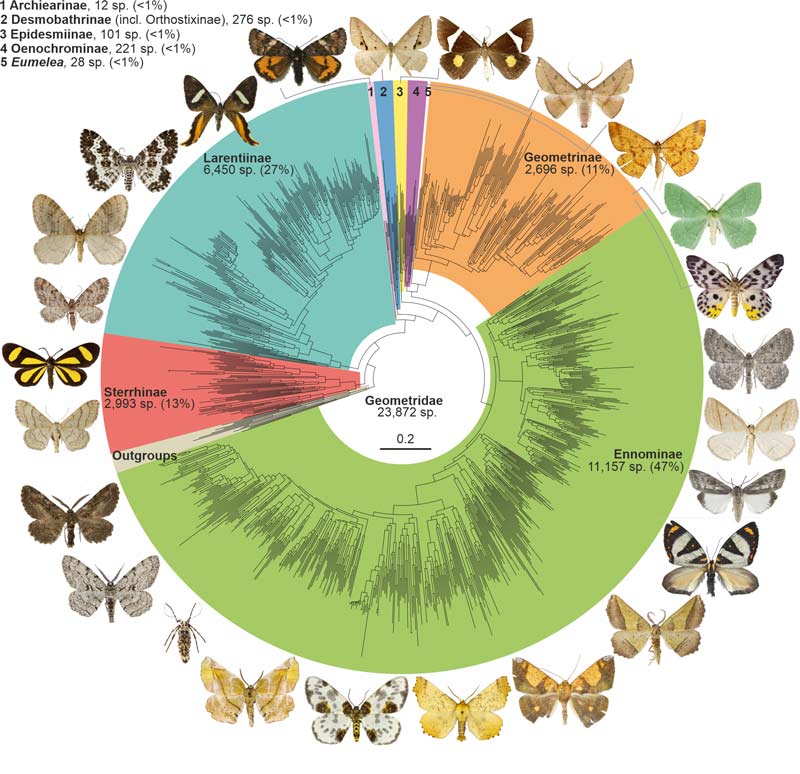
Nine subfamilies of Geometridae are usually accepted, and the relationships between eight of them (Sterrhinae, Larentiinae, Archiearinae, Desmobathrinae, Epidesmiinae, Oenochrominae sensu stricto, Geometrinae and Ennominae) are well-established (See Circular phylogeny below, derived from Murillo-Ramos et al. 2019 and published in Rajaei et al. 2022).
-
Sterrhinae alone (Murillo-Ramos et al. 2019), or Sterrhinae + Larentiinae are considered the sister group to the rest of Geometridae (e.g. Yamamoto & Sota 2007; Sihvonen et al. 2011).
-
Our understanding of the phylogenetic relationships and classification of geometrids varies greatly geographically and by taxon. The most intensively studied areas are Nearctic (e.g. Guide to the Geometridae of Canada, see McGuffin 1987 and references therein, The Moths of North America series, see Ferguson 2008 and references therein, Pohl et al. 2016) and the western Palearctic (e.g. The Geometrid Moths of Europe series, see Müller et al. 2019 and references therein). The taxonomic impediment is the highest in the tropics, which are known to be the most species rich areas (Hillebrandt 2004; Brehm et al. 2016).
-
The global fauna of Geometridae includes 202 family-group names with numerous synonymies. Those are presented, in systematic order, in the Appendix in Rajaei et al. (2022)
-
For the "family-group classification and names of Geometridae of the world", see Appendix 1, in: Rajaei et al. 2022 (https://doi.org/10.18476/2022.577933)
References
Brehm, G., Hebert, P.D.N., Colwell, R.K. Adams, M.O., Bodner, F., Friedemann, K., Möckel, L. & Fiedler, K. (2016): Turning up the heat at a hotspot: DNA barcodes reveal 80% more species of geometrid moths along an Andean elevational gradient. PlosOne 11: e0150327. https://doi.org/10.1371/journal.pone.01503277
Ferguson, D. C. (2008): Geometroidea, Geometridae (part): Ennominae (part): Abraxini, Cassymini, Macariini. In R.W. Hodges et al. (eds.), The Moths of North America, fasc. 17 (2): 1–431. The Wedge Entomological Research Foundation, Washington.
Heikkilä, M., Mutanen, M., Wahlberg, N., Sihvonen, P. & Kaila, L. (2015): Elusive ditrysian phylogeny: an account of combining systematized morphology with molecular data (Lepidoptera). BMC Evolutionary Biology 15: 1–27. https://doi.org/10.1186/s12862-015-0520-0
Hillebrand, H. (2004): On the generality of the latitudinal diversity gradient. The American Naturalist 163 (2): 192–211.
Holloway J. D. (1997): The moths of Borneo: family Geometridae, subfamilies Sterrhinae and Larentiinae. Malayan Nature Journal 51: 1–242.
Kawahara, A. Y., Plotkin, D., Espeland, M., Meusemann, K., Toussaint, E. F. A., Donath, A., Gimnich, F., Frandsen, P., Zwick, A., Dos Reis, M., Barber, J. R., Peters, R. S., Liu, S., Zhou, X., Mayer, C., Podsiadlowski, L., Storer, C., Yack, J., Misof, B. & Breinholt, J. W. (2019): Phylogenomics reveals the evolutionary timing and pattern of butterflies and moths. PNAS 116 (45): 22657–22663. https://doi.org/10.1073/pnas.1907847116
McGuffin, W. C. (1987): Guide to the Geometridae of Canada (Lepidoptera) II. Subfamily Ennominae. 4. Memoirs of the Entomological Society of Canada 119: 1–182.
Minet, J., Scoble, M. J. (1999): The drepanoid/geometroid assemblage. In: Kristensen, N. P. (ed.): Lepidoptera: evolution, systematics and biogeography, pp. 301–320.; Walter de Gruyter, Berlin. https://doi.org/10.1515/9783110804744.301
Müller, B., Erlacher, S., Hausmann, A., Rajaei, H., Sihvonen, P. & Skou, P. (2019): Ennominae II. – In: Hausmann, A., Rajaei, H., Sihvonen, P. & Skou, P. (eds.): The Geometrid Moths of Europe. 906 pp.; Brill, Leiden, https://doi.org/10.1163/9789004387485
Murillo-Ramos, L., Brehm, G., Sihvonen, P. Hausmann, A., Holm, S., Reza Ghanavi, H., Õunap, E., Truuverk, A., Staude, H., Friedrich, E., Tammaru, T. & Wahlberg, N. (2019): A comprehensive molecular phylogeny of Geometridae (Lepidoptera) with a focus on enigmatic small subfamilies. PeerJ 7: e7386. https://doi.org/10.7717/peerj.7386
Pohl, G.R., Patterson, B. & Pelham, J. P. (2016): Annotated taxonomic checklist of the Lepidoptera of North America, North of Mexico. Working paper published online by the authors at ResearchGate.net. 766 pp. DOI: 10.13140/RG.2.1.2186.3287
Rajaei, H., Greve, C., Letsch, H., Stüning, D., Wahlberg, N., Minet, J. & Misof, B. (2015): Advances in Geometroidea phylogeny, with characterization of a new family based on Pseudobiston pinratanai (Lepidoptera, Glossata). Zoologica Scripta 44 (4): 418–436. https://doi.org/10.1111/zsc.12108
Rajaei, H., Hausmann, A., Scoble, M., Wanke, D., Plotkin, D., Brehm, G., Murillo-Ramos, L. & Sihvonen, P. (2022): An online taxonomic facility of Geometridae (Lepidoptera), with an overview of global species richness and systematics. Integrative Systematics, 5 (2): 145-192. https://doi.org/10.18476/2022.577933
Regier, J. C., Mitter, C., Zwick, A., Bazinet, A. L., Cummings, M. P., Kawahara, A. Y., Sohn, J. C., Zwickl, D. J., Cho, S., Davis, D. R., Baixeras, J., Brown, J., Parr, C., Weller, S., Lees, D. C. & Mitter, K. T. (2013): A Large-Scale, Higher-Level, Molecular Phylogenetic Study of the Insect Order Lepidoptera (Moths and Butterflies). PLoS ONE 8 (3): 58568.
Sihvonen, P., Mutanen, M., Kaila, L., Brehm, G., Hausmann, A. & Staude, H. S. (2011): Comprehensive molecular sampling yields a robust phylogeny for geometrid moths (Lepidoptera: Geometridae. PLOS ONE 6 (6): e20356. https://doi.org/10.1371/journal.pone.0020356
Yamamoto, S. & Sota, T. (2007): Phylogeny of the Geometridae and the evolution of winter moths inferred from a simultaneous analysis of mitochondrial and nuclear genes. Molecular Phylogenetics and Evolution 44 (2): 711–723. https://doi.org/10.1016/j.ympev.2006.12.027